Molecular Mass Finder: Calculate Molecular Weight for Any Chemical Formula
Use this molecular mass finder to find molecular mass of any compound instantly. Type your formula or build it element by element. You get the molar mass, element breakdown, and mass percentage in one click.
What is Molecular Weight? (And How to Find Molecular Mass)
Molecular weight is the total mass of all atoms in a chemical compound. It is measured in g/mol. Every element has its own atomic mass, and when you add them all up according to the formula, you get the molecular weight of that compound.
o find molecular mass of any compound, you add up the atomic masses of all its atoms. For example, to find the molecular mass of water (H2O): Hydrogen has an atomic mass of 1.008 g/mol and there are 2 atoms, so 2 x 1.008 = 2.016. Oxygen is 15.999 g/mol. Total = 18.015 g/mol. Our molecular mass finder does this calculation automatically for any formula you enter.
How Does This Molecular Mass Finder Work?
Our tool works on standard IUPAC atomic masses. You enter your chemical formula. The tool reads each element, counts the atoms, multiplies each one by its atomic mass, and adds everything together. You get the final molar mass in under a second.
How to Find Molecular Mass of a Compound with Our Calculator
You get two modes at the top of the calculator. Pick whichever suits you.
Mode 1: Type Formula
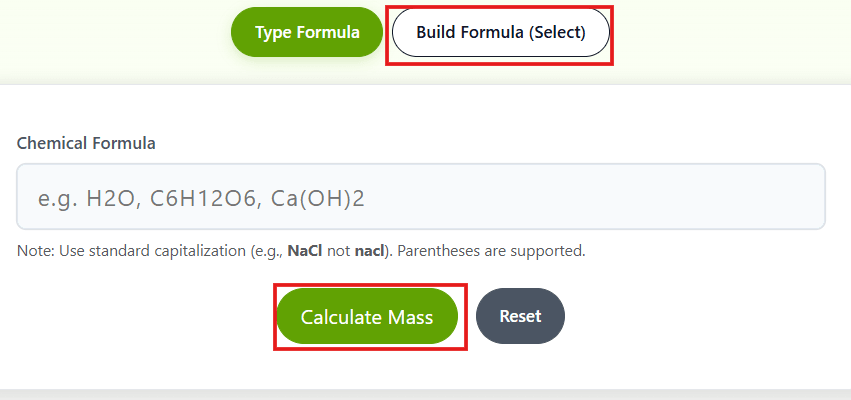
This is the fastest way to get your answer. Type your formula directly into the input box (example: NaCl, H2O, C6H12O6, Ca(OH)2)
Click Calculate Mass and your result appears instantly with a full element breakdown.
One thing to keep in mind: use correct capitalization. Write NaCl, not nacl. The tool reads element symbols exactly as written, so the format matters.
Mode 2: Build Formula (Select)
This mode is perfect if you are not confident about formula syntax or want to build it step by step.
Select your element from the dropdown, enter the number of atoms, and keep adding elements using the “+ Add Element” button
Once you have added all your elements, click Calculate Mass and get your result with the full breakdown. Both modes give you the same detailed output. Use whichever feels more comfortable to you.
How to Find Molecular Mass of an Element: Glucose Example
You are a Class 12 student and your practical record is due tomorrow. Your teacher asked you to calculate the molar mass of Glucose.
Glucose is C6H12O6.
You type that into the formula box, hit Calculate Mass, and here is what you get:
Carbon (C) × 6 = 72.066 g/mol
Hydrogen (H) × 12 = 12.096 g/mol
Oxygen (O) × 6 = 95.994 g/mol
Total Molar Mass = 180.156 g/mol
What is the Difference Between Molecular Weight and Molar Mass?
Molar mass is the mass of one mole of a substance, expressed in g/mol.
Molecular weight is technically the ratio of one molecule’s mass compared to one-twelfth of a Carbon-12 atom. It has no unit.
For school and college level chemistry, both are calculated the same way and used interchangeably. When your question says “find the molar mass of NaCl,” this calculator gives you exactly that number.
How to Find Molecular Formula from Molar Mass
Sometimes you work in reverse. You have the molar mass and you want to figure out the molecular formula. The process is: divide the molar mass by the empirical formula mass to get a whole number multiplier, then multiply each atom count in the empirical formula by that number.
For example, if you know the molar mass is 180 g/mol and the empirical formula is CH2O (which has a mass of 30 g/mol), then 180 divided by 30 = 6. So the molecular formula is C6H12O6 which is Glucose.
ur tool works the other direction. You enter a formula and get the molar mass instantly. If you need to find molecular formula from molar mass, use the empirical formula mass as your starting reference and apply the multiplier above.
Frequently Asked Questions
What is molecular weight in chemistry?
Molecular weight is the sum of the atomic masses of all atoms present in a chemical formula. It is expressed in g/mol and tells you how heavy one mole of that compound is.
Can this tool handle brackets in formulas?
Yes, The calculator fully supports brackets and nested brackets. Formulas like Ca(OH)2 and Al2(SO4)3 are parsed correctly without any issues.
How do you find the molecular mass of a compound?
Add up the atomic masses of all atoms in the compound’s formula. Multiply each element’s atomic mass by how many times it appears, then sum all values. For NaCl: Na = 22.990 + Cl = 35.45 = 58.44 g/mol. Or just type NaCl into our molecular mass finder and get the answer instantly.
How do you find the molecular mass of an element?
For a single element, the molecular mass equals the atomic mass from the periodic table. For example, the molecular mass of Carbon is 12.011 g/mol. If the element forms a diatomic molecule like O2, you multiply: 2 x 15.999 = 31.998 g/mol.
How to find average molecular mass?
Average molecular mass accounts for the natural abundance of isotopes. Multiply each isotope’s mass by its natural abundance (as a decimal) and add them all together. For most school and college problems, you use the standard atomic mass from the periodic table, which is already an abundance-weighted average. Our tool uses these standard IUPAC values.
How to find molecular mass in chemistry class?
In chemistry, you use the formula: Molecular Mass = sum of (atomic mass x number of atoms) for each element. Find the atomic masses from the periodic table, multiply by the subscript in the formula, and add everything up. Our calculator does all of this automatically using IUPAC atomic masses.
Published By: CutoffCalculator Team
Admin
This calculator tool is developed and published by the CutoffCalculator Team. Our mission is to create an all-in-one platform for students that makes academics and education smoother.
Disclaimer: Our tool uses past data and trends, so it may be inaccurate. Always check with the official universities. If you find anything wrong, please report it immediately at [email protected], and we will update it as soon as possible.