Relative Density Calculator: Calculate Relative Density or Specific Gravity
Understanding density and relative density is simpler than it sounds. Enter your substance density and reference density, and our calculator gives you the relative density result with a float or sink verdict instantly.
Relative density is defined as the ratio of the density of a substance to the density of a reference substance under the same conditions. It tells you how heavy a material is compared to something you already know, usually water.
In simple words: it is a comparison, not an absolute measurement.
Because it is a ratio, it carries no unit. You will never see “kg/m³” or “g/cm³” after a relative density value. Just a number like 7.85 or 0.6.
Water is the standard reference for solids and liquids. Its density is 1000 kg/m³ or 1 g/cm³ at room temperature. For gases, the reference is usually air.
The term “specific gravity” means the exact same thing. Both are used in physics, chemistry, and engineering. If your textbook says specific gravity, your answer from this tool is still valid.
The key difference between density and relative density is that density is an absolute value with units like kg/m³ or g/cm³, while relative density is a dimensionless ratio. Knowing both helps you understand not just how heavy a substance is, but how it behaves compared to water or any other reference material.
How to Calculate Relative Density Calculator with Our Tool: Four Simple Steps
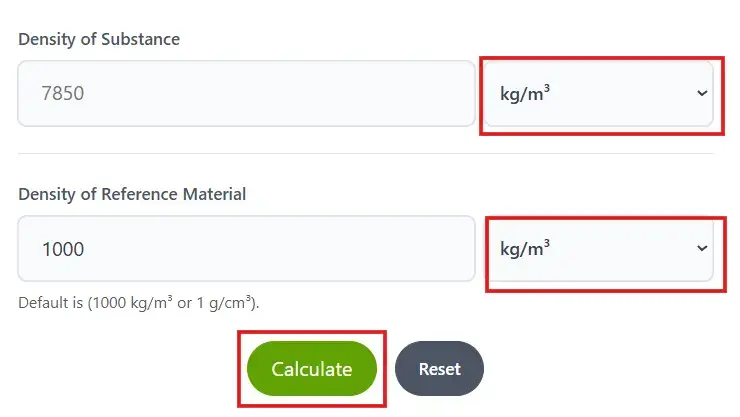
Step 1: Enter the Density of Your Substance
Type the density of the material you want to check. You can also select your unit from the dropdown: kg/m³, g/cm³, kg/L, or lb/ft³. Our tool handles the unit conversion automatically.
Step 2: Enter the Density of Reference Material
By default, the reference density is set to 1000 kg/m³, which is water at room temperature. If your problem uses a different reference material like mercury or oil, you can change this value.
Step 3: Click Calculate
Click the Calculate button and your relative density result appears instantly. The tool also tells you whether the substance will float, sink, or suspend in the reference material.
Step 4: Reset and Try Again
No calculation limit. Click Reset and you can start fresh with new values right away.
Example:
The density of iron is 7850 kg/m³. Find its relative density with respect to water.
Solutions:
Enter 7850 in the Substance Density box
keep the unit as kg/m³
The reference density is already set to 1000 kg/m³ (water).
Click Calculate.
Result: 7.85
Since 7.85 is greater than 1, the tool tells you iron will sink in water. Your assignment answer is done in under 10 seconds.
This is what our calculator does every time you click Calculate. It gives you the relative density value and immediately tells you whether the substance floats, sinks, or suspends in your reference material.
Relative Density Formula?
The formula used in this calculator is:
Where:
ρ substance = Density of the given material
ρ reference = Density of the reference material (water = 1000 kg/m³ or 1 g/cm³)
Relative Density vs Specific Gravity: Are They the Same?
Yes, they are. Specific gravity and relative density mean the same thing. Both compare a substance’s density to the density of water. Some textbooks use “specific gravity” and others say “relative density.” Both give you the same number using the same formula.
Frequently Asked Questions
Can relative density be less than 1?
Yes, it can. If a substance is lighter than water, its relative density will be less than 1. For example, wood has a relative density of around 0.6, which is why it floats.
Is relative density the same as density?
No, Density is an absolute value with units like kg/m³ or g/cm³. Relative density is a comparison between two densities. It is a ratio, so it has no unit. Density tells you how heavy something is. Relative density tells you how heavy it is compared to a reference.
What happens when relative density equals 1?
When relative density is exactly 1, the substance has the same density as the reference material. It will neither float nor sink. It will suspend neutrally in the fluid. This is also called neutral buoyancy.
Why is water used as the reference material?
Water is the most common liquid on Earth and has a clean, easy-to-remember density of 1 g/cm³ or 1000 kg/m³. It makes comparisons simple and consistent across all fields, from physics to engineering to chemistry.
Published By: CutoffCalculator Team
Admin
This calculator tool is developed and published by the CutoffCalculator Team. Our mission is to create an all-in-one platform for students that makes academics and education smoother.
Disclaimer: Our tool uses past data and trends, so it may be inaccurate. Always check with the official universities. If you find anything wrong, please report it immediately at [email protected], and we will update it as soon as possible.